China’s Massive WZ-9 Divine Eagle Drone Now Operating from South China Sea Base
China’s deployment of its most advanced long-range surveillance drone to the South China Sea is a major challenge to US stealth aircraft and air superiority in the region, according to a Chinese military commentator.
China’s large, jet-powered, twin-fuselage WZ-9 Divine Eagle drone has been operating, at least sporadically, out of an airbase on the highly-strategic Hainan Island at the northern end of the hotly contested South China Sea since at least Dec. 4. This is a new indication that this highly important aircraft is now at least in a semi-operational state.
The jet-powered unmanned aerial vehicle (UAV) operates at altitudes of up to 25,000 metres (82,000 feet), can fly for up to 35 hours and its radars can see up to 500 km (310 miles) away, enabling constant surveillance across vast maritime regions.
The WZ-9 is a high-altitude, long-endurance (HALE) uncrewed ‘sensor truck’ that carries multiple radars capable of spotting and tracking targets over vast areas. These include objects in the air and on the surface below, as well as producing high-quality map-like radar images. While the operational status of the Divine Eagle is unclear, operations from Hainan would make perfect sense for providing valuable broad-area early warning and surveillance coverage out into the South China Sea and potentially far beyond.
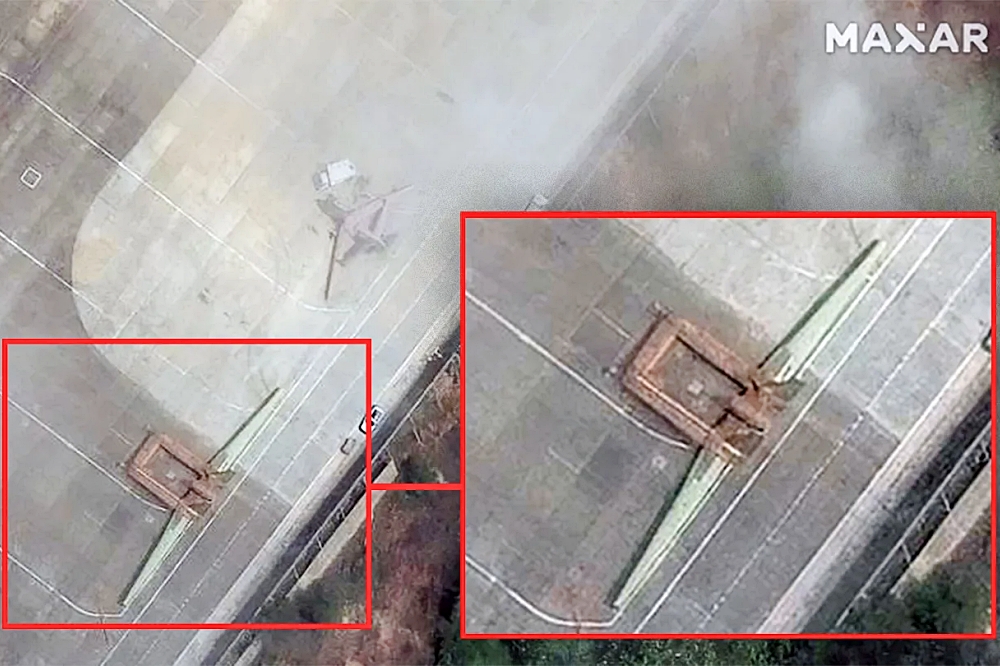
A satellite image TWZ obtained from Planet Labs, seen below, shows the WZ-9 drone at Ledong Air Base, also known as Foluo Northeast Air Base, on Dec. 4, 2024. Ledong/Foluo is a People’s Liberation Army Navy (PLAN) facility situated at Hainan’s southwestern end. Hainan is an absolutely critical location for the People’s Liberation Army that hosts multiple bases, including two sprawling naval facilities, one of which supports the country’s second strike nuclear deterrent and features a submarine cave complex.
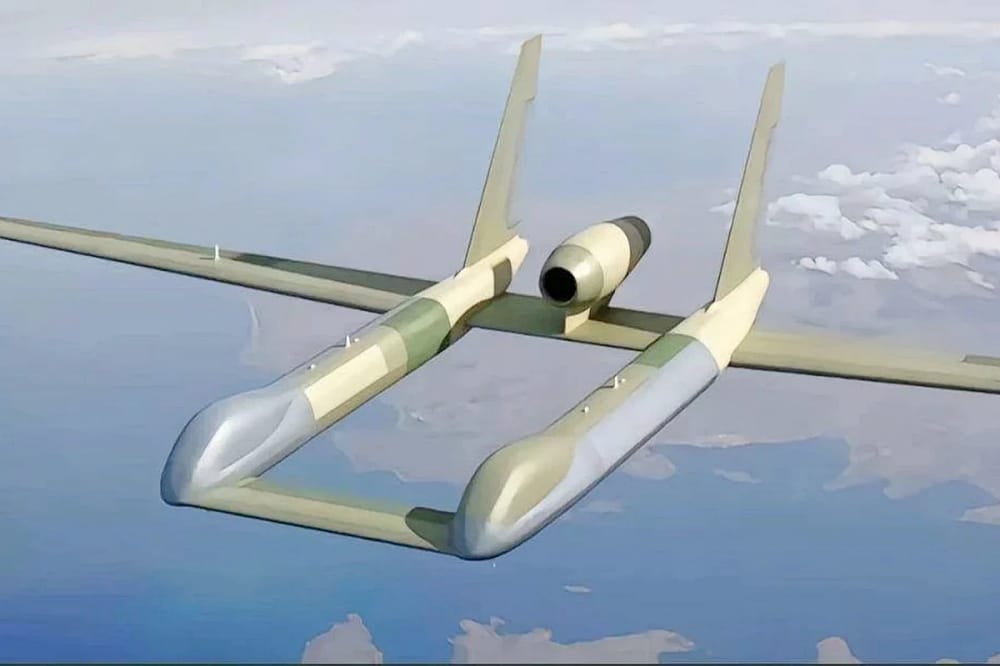
Details about the WZ-9, the development of which reportedly traces back at least to the early 2010s, remain limited and it’s unknown how many examples may currently exist. Imagery of the exotic-looking Divine Eagle that has emerged to date, along with renderings and models, show it has a very long high-aspect-ratio wing at the rear, as well as a smaller wing structure between the front ends of the two fuselages serving as a forward stabilizer. The drone is powered by a single jet engine mounted in a nacelle pod on top of the main wing between its two vertical tails.
The span of the WZ-9’s main wing is around 147 feet (45 meters), but its overall length is just shy of 50 feet (15 meters). For comparison, the U.S. RQ-4 Global Hawk HALE drone has a wingspan of just under 131 feet (nearly 40 meters) and is almost 48 feet (14.5 meters) long.
At least one model has previously emerged indicating that the WZ-9 has at least two large side-looking radars (SLARs), one in each fuselage facing outward. These radars may have ground moving-target indicator and air moving-target indicator (GMTI/AMTI) capabilities, as well as the ability to produce synthetic aperture radar (SAR) imagery.
The aircraft were spotted at Ledong airbase, also known as Foluo Northeast Air Base, near other strategic sites, including Yulin Naval Base, which houses nuclear-powered ballistic missile submarines, the report said.
Former People’s Liberation Army instructor Song Zhongping said the drone’s array of radars seriously challenged the US military’s reliance on stealth technology for air superiority and weakened US combat strength in the Indo-Pacific.
“Its twin-fuselage design incorporates domes in the front sections that support a range of advanced radar systems that are built to track stealth aircraft, warships, and submarines over vast distances,”
Song said.
Sources: The War Zone; South China Morning Post