China’s Commercial Mach-4 Drone to Make First Flight Next Year
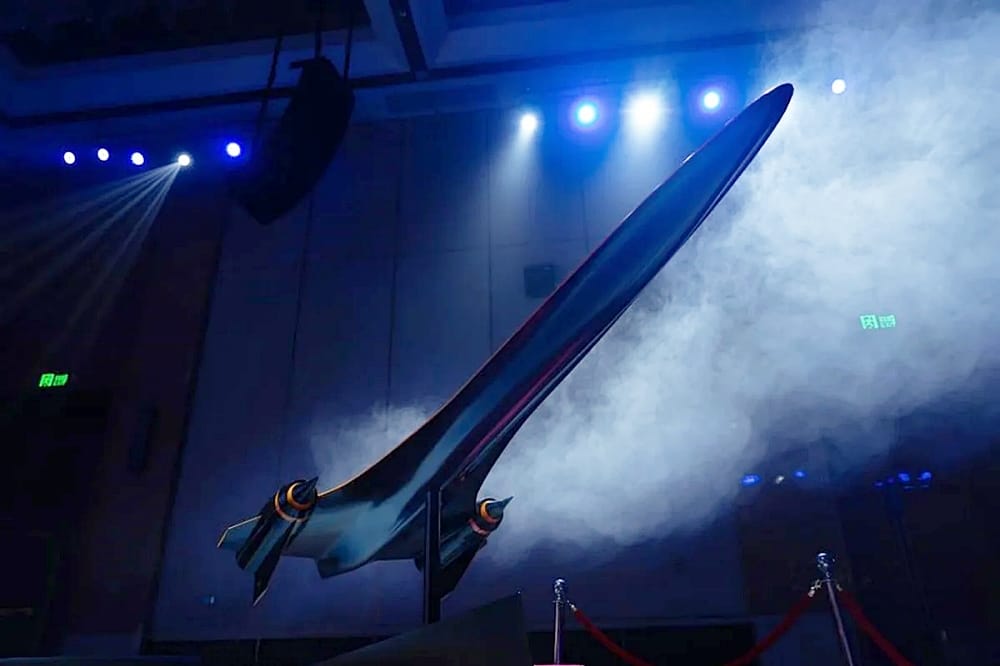
A Chinese start-up is aiming to develop a supersonic drone capable of reaching speeds four times the speed of sound. Lingkong Tianxing Technology, the company behind the project, unveiled the unmanned aerial vehicle (UAV), named Cuantianhou or “Soaring Stone Monkey,” at a news conference in Chengdu, the capital city of Southwest China’s Sichuan Province.
The model’s development marks a significant step in adapting military hypersonic technology for commercial use. Cuantianhou’s design is part of the firm’s broader ambitions to create a supersonic passenger jet.
The UAV’s first test flight is scheduled for next year, signaling China’s growing advancements in supersonic technology and its potential civilian applications.
In October 2024, Lingkong Tianxing tested a prototype commercial plane capable of nearly double the speed of the Concorde’s supersonic performance.
Supersonic Tech Advancements
The Chinese firm’s supersonic drone is claimed to be capable of reaching Mach 4.2 at an altitude of 12.4 miles (20 kilometers), more than twice the speed of Concorde.
Weighing 1.5 tonnes and measuring seven meters long, the unmanned aerial vehicle is powered by two detonation engines. Its first flight is scheduled for next year as part of a larger initiative to develop a high-speed passenger jet, projected for prototype testing by 2030.
Supersonic technology, traditionally a military asset, is now being adapted for commercial use. Several international start-ups, including ventures in the United States and Switzerland, are exploring similar advancements.
The Chinese drone and its related projects signal growing competition in hypersonic innovation, reflecting broader efforts to bridge military and civilian applications.
In October, Lingkong Tianxing Technology tested a prototype commercial plane capable of nearly double the speed of the Concorde’s supersonic performance.
Steady Progress
Lingkong Tianxing is accelerating its research and development in supersonic aircraft.
In October, the company successfully completed test flights of its Yunxing supersonic aircraft, evaluating key technologies like aerodynamics, heat resistance, and control systems. Initially scheduled for a full prototype flight in 2027, the Yunxing UAV’s timeline has been advanced to 2026 due to significant progress.
The company’s Cuantianhou UAV incorporates optimized aerodynamics compared to Yunxing, eliminating the front canard and adjusting components for a more efficient angle of attack.
Recent tests demonstrated the UAV’s capabilities, including a climb of 6.21 miles (10 kilometers) with speeds from Mach 3.3 to Mach 4.1 and dynamic pressure ranges of 39 to 114 kPa. The UAV showcased impressive fuel efficiency, consuming just 13.2 pounds (6 kilograms) of fuel to cover 31 miles (50 kilometers).
Lingkong Tianxing has also introduced its next-generation Jindou-400S detonation engine, an upgraded version of its predecessor. The new engine features multiple ignitions, weighs 100kg—down from 300kg—and produces 4,000 Newtons of thrust, an improvement from 2,500 Newtons. With a reduced length of 1.9 meters, the engine supports speeds up to Mach 4.2 while improving power-to-weight ratio and thrust.
The UAV series’ rapid iteration stems from extensive testing, including 88 test flights over six years, and the use of advanced supercomputing simulations. The company’s proprietary 3D printing technology has further enhanced the airframe design, reports SCMP.
According to the firm, with advancements in noise suppression, materials science, and flight control systems, the development of supersonic passenger flights is becoming increasingly feasible.
Source: Interesting Engineering