Baykar Starts Training Employees for Ukraine Drone Plant
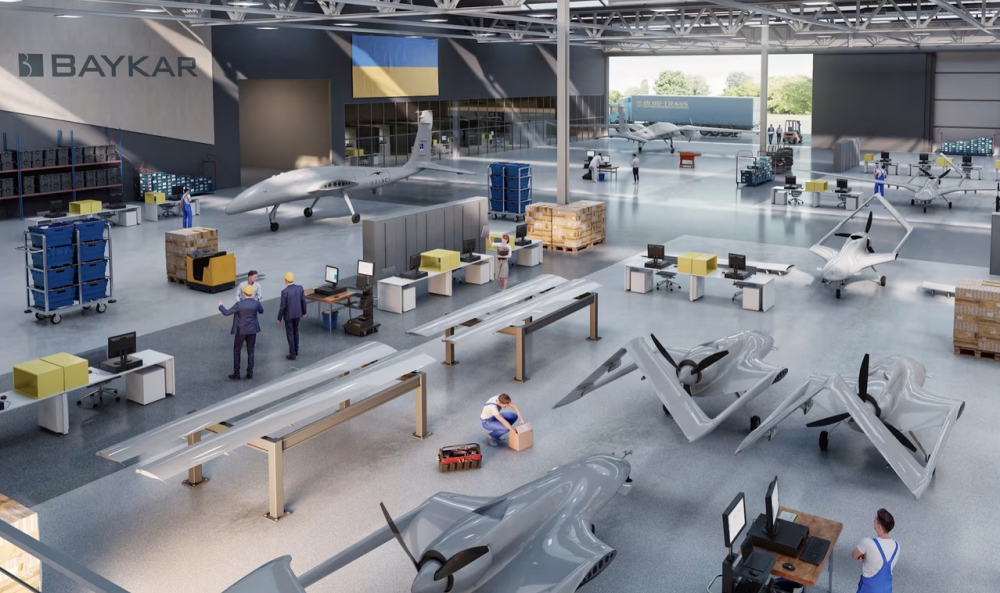
Turkey’s Baykar has begun training future employees for a drone manufacturing plant under construction in Ukraine, a move that signals confidence in the war-torn nation’s industrial future despite ongoing hostilities.
Haluk Bayraktar, the company’s chief executive, shared details of the initiative in a recent interview with Ukrinform, a Ukrainian state news agency, underscoring the firm’s commitment to a $100 million investment in the country.
The training program, already underway in Turkey, involves students and professionals from Ukraine, laying the groundwork for a factory that could produce up to 120 combat drones annually once operational.
The training effort includes 20 students from the Kyiv Aviation Institute and 14 Ukrainian professionals, all of whom are honing their skills at Baykar’s facilities in Turkey. The program, which spans at least nine months, is designed to prepare a skilled workforce capable of operating the new plant as soon as conditions allow.
“We’re expecting another group to join during this period,” Bayraktar told Ukrinform. “Our goal is to train personnel in advance, so we’re ready to launch production when the time comes.”
The executive’s remarks reflect a strategic approach, blending optimism with pragmatism as Baykar navigates the complexities of establishing a foothold in a conflict zone.
Baykar, renowned for its Bayraktar TB2 combat drones that have proven pivotal in Ukraine’s defense against Russia, is pressing ahead with its Ukrainian ventures despite the war’s uncertainties. The company has already ordered machinery and equipment for the facility, a step that Bayraktar described as evidence of progress
“We’ve secured the necessary technology and tools,” he said. “We’re moving forward with hope for a just peace, and we’d like to start production as soon as possible after that. We’re very close to being ready.”
His words suggest a calculated bet on Ukraine’s resilience, even as Russian forces continue their assault into the conflict’s fourth year.
The factory, one of three projects Baykar is funding in Ukraine with its $100 million investment, broke ground prior to February 2024, when Bayraktar projected a 12-month timeline for construction. By early 2025, he anticipated, the physical structure would be complete, paving the way for the installation of specialized equipment.
The plant’s capacity—estimated at 120 drones per year—remains flexible, with Baykar yet to finalize whether it will produce the battle-tested TB2 model or its newer, more advanced successor, the TB3. This ambiguity reflects the company’s adaptability, tailoring its output to Ukraine’s evolving military needs.
The Bayraktar TB2, a medium-altitude, long-endurance unmanned aerial vehicle, gained global attention for its role in Ukraine’s early resistance to Russia’s 2022 invasion. Armed with laser-guided bombs, the TB2 can loiter for up to 27 hours, striking targets with precision from altitudes exceeding 25,000 feet.
Its successor, the TB3, builds on this foundation with enhanced features: larger dimensions, a higher payload capacity, and foldable wings designed for deployment from naval vessels like aircraft carriers or amphibious assault ships. Unveiled in 2023, the TB3 completed its first carrier-based takeoff and landing tests aboard Turkey’s TCG Anadolu, hinting at its potential to diversify Ukraine’s drone arsenal if selected for production.
Baykar’s investment in Ukraine dates back to a pre-war partnership that deepened after Russia’s aggression began. In 2021, Ukraine purchased dozens of TB2 drones, integrating them into its air force with devastating effect against Russian armor and supply lines. The relationship solidified further in August 2022, when Baykar announced plans to build a manufacturing facility near Kyiv, a decision bolstered by Turkey’s neutral yet supportive stance toward Ukraine.
Despite the invasion’s escalation, Bayraktar has remained steadfast.
“The war hasn’t derailed us,” he said in February 2024, addressing concerns about the project’s viability. “Our plans are on track, and nothing will stop them.”
The training program in Turkey marks a proactive step toward realizing this vision. The Kyiv Aviation Institute, a prestigious institution with roots in Soviet-era aerospace engineering, provides a steady pipeline of talent, while the 14 professionals—likely experienced technicians or managers—bring practical expertise.
Baykar’s facilities, located near Istanbul, offer state-of-the-art simulators, workshops, and live testing grounds, immersing trainees in the intricacies of drone assembly and operation.
“This is about building capacity from the ground up,” said Ahmet Yılmaz, a Turkish defense analyst familiar with Baykar’s operations, in a recent interview. “They’re not just sending drones—they’re transferring knowledge.”
The factory’s construction, meanwhile, has progressed despite logistical challenges posed by the war. Located in an undisclosed area near Kyiv, the site benefits from Ukraine’s existing industrial infrastructure, though security concerns have slowed some phases.
Ukrainian officials, speaking anonymously due to the sensitivity of military projects, confirmed in late 2024 that Baykar had coordinated with local authorities to safeguard the facility from Russian airstrikes. The company’s $100 million investment also includes a research center and a service hub, though the factory remains the centerpiece, promising jobs and technological advancement in a nation desperate for both.
Turkey’s role as a mediator in the Russia-Ukraine conflict adds complexity to Baykar’s endeavor. Ankara has supplied Ukraine with weapons while maintaining trade ties with Moscow, a balancing act that has drawn scrutiny. Baykar, a private firm led by brothers Haluk and Selçuk Bayraktar—sons-in-law of Turkish President Recep Tayyip Erdoğan—operates with tacit government backing, yet insists its Ukrainian projects are commercially driven.
“This is a business decision, not a political one,” Haluk Bayraktar told reporters in 2023, deflecting claims of geopolitical maneuvering. Still, the TB2’s success against Russian forces has elevated Turkey’s defense industry, with exports surging 70% since 2022, according to the Turkish Exporters Assembly.
For Ukraine, the factory represents more than drones—it’s a lifeline to self-sufficiency. Kyiv has leaned heavily on Western aid, receiving over $50 billion in military support from the United States alone since 2022. Yet domestic production remains a priority as foreign supplies fluctuate.
“Baykar’s investment is a vote of confidence,” said Oleksandr Danylyuk, a former Ukrainian defense official, in a statement last month. “It’s about reducing reliance on imports and building our own capabilities.”
The plant’s output, whether TB2s or TB3s, could bolster Ukraine’s ability to strike Russian targets deep behind the front lines, a tactic that has kept Moscow’s forces on edge.
Uncertainty lingers over when production can begin. Russia’s relentless bombardment, including a March 1, 2025, claim of downing six U.S.-made JDAM bombs, underscores the fragility of Ukraine’s industrial zones.
Baykar’s timeline hinges on a ceasefire or at least a stabilization of the conflict, outcomes that remain elusive as fighting intensifies in the east. “We’re preparing for peace, but we’re realistic,” Bayraktar acknowledged in his Ukrinform interview. “The moment conditions allow, we’ll move in.”
Skeptics question whether Baykar can deliver under such pressure. “The factory’s a bold idea, but war doesn’t respect schedules,” noted Michael Kofman, a Russia expert at the Carnegie Endowment, in a recent analysis.
“Equipment can sit idle if the front line creeps closer.”
Others see the training program as a hedge against this risk, ensuring a workforce is ready regardless of delays. Baykar’s track record—delivering TB2s to over 20 countries since 2018—lends credence to its resolve, though Ukraine’s volatile landscape tests even the most determined players.
As Baykar trains its Ukrainian recruits and installs machinery thousands of miles away, the project stands as a testament to ambition amid adversity. Whether producing TB2s that have already reshaped the battlefield or TB3s poised to redefine naval drone warfare, the factory could alter Ukraine’s military calculus.
For now, Haluk Bayraktar’s vision rests on a fragile hope: that peace, or at least a pause, will unlock the potential of a partnership forged in war’s shadow.
Source: Bulgarian Military