Artificial Intelligence Triumphs in World’s Most Sophisticated Autonomous Drone Race in Abu Dhabi
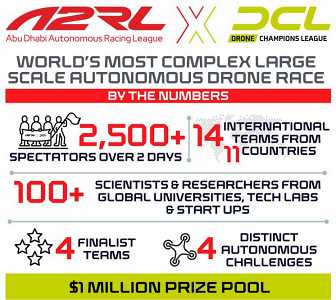
The Abu Dhabi Autonomous Racing League (A2RL), part of the Advanced Technology Research Council (ATRC), in collaboration with the Drone Champions League (DCL), concluded the inaugural A2RL x DCL Autonomous Drone Championship in the Middle East, at ADNEC Marina Hall, Abu Dhabi, UAE.
In a major breakthrough for autonomous flight and aerial robotics, Team MavLab’s AI drone outpaced a world-leading human pilot to win the AI vs Human Challenge. The head-to-head duel was the most complex ever staged, featuring finalists from the DCL Falcon Cup—some of the top drone pilots in the world.
Over two high-intensity days, 14 international teams qualified for the finals week, with the top four advancing to compete across multiple challenging race formats. Teams from the UAE, Netherlands, Austria, South Korea, the Czech Republic, Mexico, Turkey, China, Spain, Canada and the USA represented a mix of university labs, research institutes, and startup innovators.
Each team raced a standardized drone equipped with the compact yet powerful NVIDIA Jetson Orin NX computing module, a forward-facing camera, and an inertial measurement unit (IMU) for onboard perception and control. With no human input, the drones relied entirely on real-time processing and AI-driven decision-making to reach speeds exceeding 150 km/h through a complex race environment.
The course design pushed the boundaries of perception-based autonomy—featuring wide gate spacing, irregular lighting, and minimal visual markers. The use of rolling shutter cameras further heightened the difficulty, testing each team’s ability to deliver fast, stable performance under demanding conditions. This marked the first time an autonomous drone race of this scale and complexity was staged on such a visually sparse track, underscoring the ambition and technical challenge of the event.
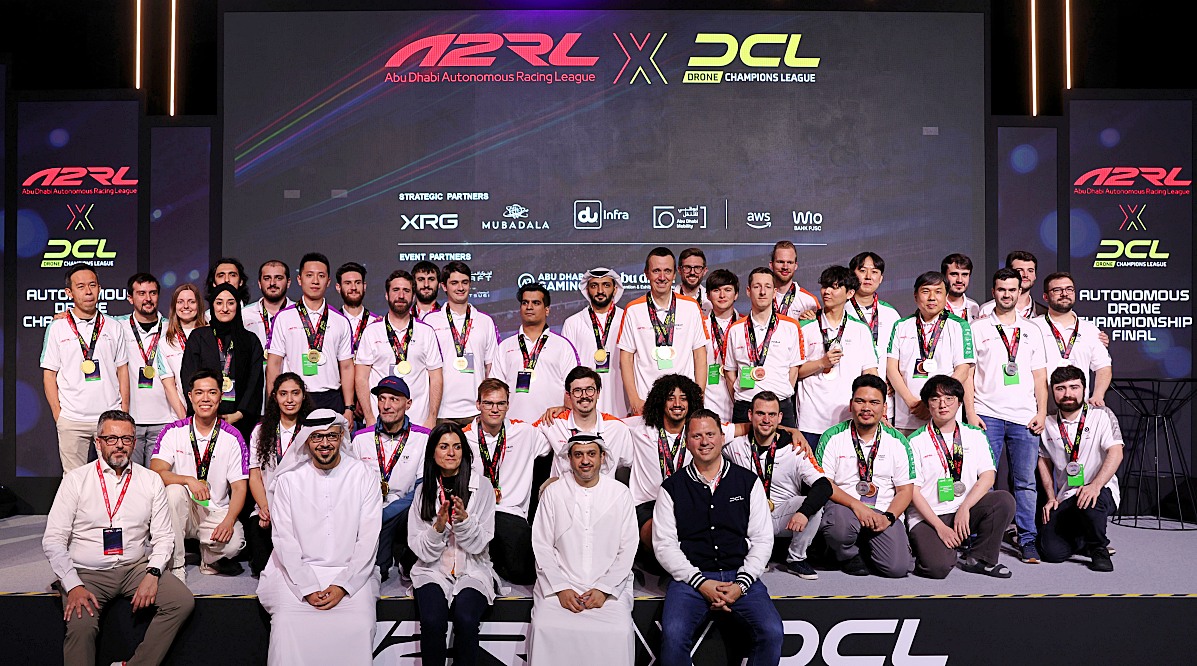
Championship Highlights
- AI Grand Challenge Winner: MavLab (TU Delft) set the fastest time on the 170-meter course, completing two laps (22 gates) in just 17 seconds.
- AI vs Human Showdown Winner: MavLab’s autonomous drone outpaced top human pilot—in a landmark AI vs Human showdown.
- Multi-Autonomous Drone Race Winner: TII Racing emerged victorious in the multi-drone format, in a high-speed test of AI coordination and collision avoidance.
- Autonomous Drag Race Winner: MavLab (TU Delft) claimed victory in the world’s first AI-only drag race, demonstrating straight-line speed and control under high acceleration against the championship’s top teams.
“The future of flight doesn’t live in a lab—it lives on the racetrack,” said Stephane Timpano, CEO of ASPIRE, the hosting entity of the Abu Dhabi Autonomous Racing League. “What we saw this weekend brings us closer to scaling autonomous systems in everyday life.” Markus Stampfer, Executive Chairman of DCL, added: “We brought elite racing conditions to autonomous flight—and the AI rose to the challenge. This was a major leap for both sport and technology.”
Ecstatic after clinching three top titles, Christophe De Wagter, team principal of MavLab, shared,
“Winning the AI Grand Challenge and the AI vs Human race is a huge milestone for our team. It validates years of research and experimentation in autonomous flight. To see our algorithms outperform in such a high-pressure environment and take home the largest share of the prize pool, is incredibly rewarding.”
Team lead Christophe De Wagter is both exhausted and exhilarated:
“I always wondered when AI would be able to compete with human drone racing pilots in real competitions. I’m extremely proud of the team that we were able to make it happen already this year. I hope that this achievement and this type of competition in general forms a springboard for real-world robot applications.”
AI that Directly Commands the Motors
One of the core new elements of the drone’s AI is the use of a deep neural network that doesn’t send control commands to a traditional human controller, but directly to the motors. These networks were originally developed by the Advanced Concepts Team at the European Space Agency (ESA) under the name of “Guidance and Control Nets”. Traditional, human-engineered algorithms for optimal control were computationally so expensive that they would never be able to run onboard resource-constrained systems such as drones or satellites. ESA found that deep neural networks were able to mimick the outcomes of traditional algorithms, while requiring orders of magnitude less processing time. As it was hard to test whether the networks would perform well on real hardware in space, a collaboration was formed with the MAVLab at TU Delft.
“We now train the deep neural networks with reinforcement learning, a form of learning by trial and error. ”, says Christophe De Wagter. “This allows the drone to more closely approach the physical limits of the system. To get there, though, we had to redesign not only the training procedure for the control, but also how we can learn about the drone’s dynamics from its own onboard sensory data.”
Optimising Robotic Applications
The highly efficient AI developed for robust perception and optimal control are not only vital to autonomous racing drones but will extend to other robots. Christophe De Wagter:
“Robot AI is limited by the required computational and energy resources. Autonomous drone racing is an ideal test case for developing and demonstrating highly-efficient, robust AI. Flying drones faster will be important for many economic and societal applications, ranging from delivering blood samples and defibrillators in time to finding people in natural disaster scenarios. Moreover, we can use the developed methods to strive not for optimal time but for other criteria, such as optimal energy or safety. This will have an impact on many other applications, from vacuum robots to self-driving cars”.
The TU Delft team: Anton Lang, Quentin Missine, Aderik Verraest, Erin Lucassen, Till Blaha, Robin Ferede, Stavrow Bahnam, Christophe De Wagter and Guido de Croon.
The A2RL X DCL Drone STEM Program, designed in collaboration with UNICEF and under the supervision of the ATRC, has trained over 100 Emirati students this year. Over 60% earned the prestigious Trusted Operator Program certification and 24 achieved perfect scores, showcasing the cutting-edge aviation skills being developed as part of the program.
With the drone finale now in the books, all eyes turn to Season 2 of A2RL’s autonomous car racing series, set for Q4 2025 at Yas Marina Circuit in Abu Dhabi.
*Source: AETOSWire
Sources: Technology Innovation Institute; MAVLab